Is truth relative, or does absolute truth really exist? The answer to that question affects every area of life—from morality and logic to the Christian faith itself.
Roger Smalling, D.Min
What relativism claims
Any other premise is self-invalidating. Take, for instance, the thought, “Truth does not exist.” Is that statement a truth? If so, truth exists, and the statement “truth does not exist” is refuted.
A labyrinth of contradictions greets us the instant we adopt any other premise than “truth exists.” Trying to make sense out of anything else is like chewing gristle. The more we try, the tougher it becomes. It can’t be swallowed.
People rarely say blatantly, “Truth does not exist.” Yet we frequently encounter the statement in another form: “Truth is relative to the individual.”
The relativist insists that when a person claims to have perceived a truth, he is really observing a process going on in his mind, since there are no objective realities. This assertion is as easily disproven as the idea that truth doesn’t exist.
The self-contradiction of relativism
For example, if truth is considered “relative to the individual,” what can we say about the claim that truth is relative to the individual? Is that an absolute or relative truth? If absolute, then there exists a truth that is not relative to any individual. If it is relative, then the premise is not valid.
The stock phrase “that is true for you” is simply nonsense.
Some relativists assert that reality itself is just a state of mind. That is, reality is altered or controlled by our state of consciousness. This is the basic premise behind occult mind-science, which leads to severe mental and personality disturbances in some people. Nevertheless, this type of thinking thoroughly permeates our culture.
The educational system, right from primary school through college, is rife with it: values clarification, the “open classroom,” and certain social studies programs are samples of ideas invented and pushed by relativists.
It forms the basis for much of our popular media, right down to some of the cartoons. These show heroes altering reality by mind power and just imagining things into existence.
Can truth be relative?
No one can logically sustain the notion that truth is relative. It is self-contradicting and requires no further refutation. Like the proverbial snake that bites itself and dies, relativism destroys itself.
Truth, logic, and reality
We can kill this snake another way: Before a person begins to reason about any philosophy whatsoever, he must accept logic as the valid criterion for evaluating truth.
If anyone wishes to question the validity of logic as a criterion for truth, he must do so without the assistance of logic. Failure to do so deprives him of the right to reason about anything, regardless of what the philosophy might be, including relativism.
Why logic requires absolute truth
Is it absolutely true that reason is valid? If so, then absolute truth exists. At this point, the relativist crashes into the wall of reality. He forfeits the right to use reason to validate his denial of absolutes.
The only way a relativist can be consistent is to avoid thinking. If he does engage in reasoning, he must be careful to view his conclusions not as absolute truths but rather as personal perceptions. On what basis, then, would he promote his conclusions to others?
In fact, he is deprived of the right to even consider it absolutely true that his conclusions are not absolutely true! Relativism is a legitimate philosophy as long as one is careful not to think, act, or speak.
The relationship between truth and reality
Relativism is so far from reality that anyone attempting to follow the premises to their logical conclusions could be a danger to himself and others. After all, a driver who imagines an automobile bearing down on him and thinks it isn’t there unless he believes it is there should not have a license. I would hate to be a passenger in a vehicle driven by a consistent relativist.
Even worse, he might imagine himself a bird simply because he thinks it. Such thinking in itself is harmless until he tries to fly off a building. If he is not restrained, his philosophy could be short-lived.
At the risk of appearing facetious, I ask: What else is a mentally ill person apart from a consistent relativist? Most relativists avoid incarceration because they do not live consistently with their philosophy.
Schizophrenia is defined as a separation from reality. The schizophrenic is characterized by a dogged refusal to recognize any discrepancy between his state of mind and reality. In practical terms, not only are psychologists disqualified from being relativists, but they must also classify relativism as a form of schizophrenia.
The relationship between truth and reality
The absolute nature of reality must exist in the mind of the psychologist before he can declare anyone to be mentally ill. But if the psychologist is a relativist, what then is his frame of reference? If he has none, then on what grounds can he make such a declaration?
If relativism is correct, the patient has just as much right to declare the psychologist insane. Relativism is a mental aberration, or schizophrenia is a philosophy.
When we say truth is absolute, we mean it is independent of human perception of its existence. By truth we mean that which exists whether we perceive it or not. Having established objective reality, we can draw several conclusions about truth in general.
Since truth is absolute, it must also be universal. Truth is independent of human perception, so it doesn’t matter if we’re talking about one person or millions. In both scenarios, truth remains independent because it is based on reality itself rather than our perceptions of it. For example, it was once universally believed that the earth was flat. But belief was merely a unanimous misperception. The world was as round then as it is today.
The nature of truth, not a human ability to identify it, is reality. At all times, we must clarify that distinction. People do not perceive events the same way. Such a distinction doesn’t change the nature of the event. When we are talking about perception, then we can discuss who perceives the event most accurately. But this is different from the facts of the event itself.
Since truth is universal, it applies to every individual in the world. It may not have the same importance or relevance to everyone. Nevertheless, a fact is a fact, regardless of who perceives it.
Is truth universal and eternal?
All truth is universal, eternal, and absolute. Example: It will be true forever that at this time you were reading this article. This fact will be true tomorrow as well as a billion years from now, regardless of whether anyone exists to know it.
Sometimes relativists use examples from science to try to refute these claims. They refer to various theories that were considered facts for centuries but have since been proven wrong. Galileo disproved Copernican astronomy. Einstein’s relativity has overthrown Newtonian physics.
Such examples fail to distinguish between reality and the perception of reality. No scientist today would ever say that in Copernicus’ day the sun revolved around the earth. That’s why such examples can be thrown out of court as evidence.
The same is true with relativistic attempts to point out the differences in diverse cultures. It makes no real difference whether it is one individual misperceiving reality or a whole society. An error is an error.
If, for example, God exists, then atheistic societies are in error. If God does not exist, then theistic societies are in error. Since God’s existence is not dependent upon human perception or belief, one is right and one is wrong.
Truth, therefore, is absolute, universal, and eternal. By this definition, we mean that truth is independent of our perception of its existence. While relativists protest this conclusion, they are unable to show how it can be logically refuted. But then, logic is not their forte. Nor is it of value.
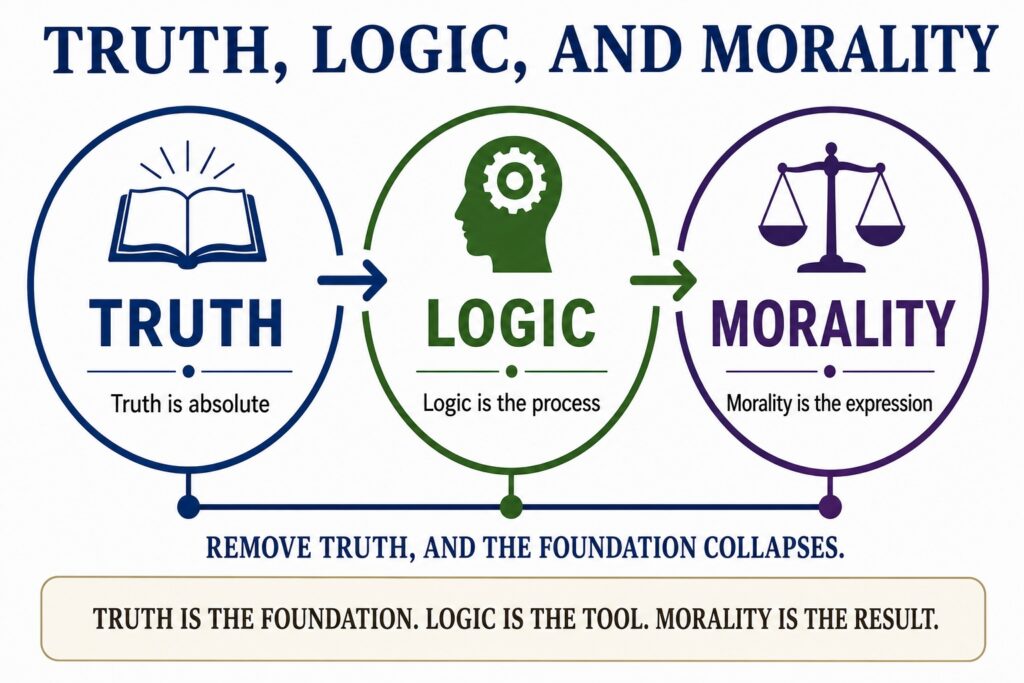
Truth and morality
Having established the nature of truth, we can now turn our attention to a related and crucial matter: morality.
Just as the nature of truth is absolute, so too is morality. Otherwise the issue of lying would have nothing to do with truth. If someone were to dispute this, we could ask if what he is saying is absolutely true or if he is merely talking relatively.
Why morality cannot be relative
If there exists an inseparable link between truth and morality, as the example of lying shows, then whatever is true about truth itself must also be true of morality in general. Moral relativism is undermined by the same arguments that challenge philosophical relativism. Absolute, universal, and eternal moral laws must exist along with absolute truth.
This means some things are wrong regardless of who likes it or not. Universal moral laws are applicable to every society regardless of whether or not a culture acknowledges them.
Finally, moral truths are eternal. Their absolute and universal nature can never change. It is not useful to say, “Times have changed.” Time may change, but truth and morality logically cannot.
Truth versus human perception
Again, we are not talking about perception. Man’s opinions as to what is right or wrong vary considerably between individuals and cultures. This in itself does not constitute evidence that morality is relative to the individual or culture. It only means some people are more correct morally than others, since both truth and morality must be logical absolutes.
Just because we proved truth and morality are absolutes doesn’t mean someone knows what they are. Observable and verifiable facts exist. Otherwise, we could draw no conclusions about anything, think about morality, or apply any of its precepts.
At this point I am not attempting to demonstrate what is right or wrong in any context. I am merely presenting the inherent irrationality of relativism, whether philosophical or moral.
Further, I am not devaluing human perceptions. I am showing that truth and morality are not dependent on our perceptions for their existence or validity.
In conclusion, we have shown why those who esteem logic must abandon relativism regardless of its disguises. It has no rational defense. Those who defend it declare they place no value on reason.
Having shown truth to be absolute, universal, and eternal, we are now free to discover facts and come to unshakeable truth.
Relativism inside the church
Relativism is an all-pervasive philosophy in our times. It dominates the educational system, permeates television programming, influences decisions of the higher courts, and is rapidly forming the fabric of modern culture.
Christians must be exceptionally careful not to let it infiltrate the Church. It wears many disguises. One comes in the form of the “balance of truth” idea. Christian leaders anxious to reconcile believers with differences currently use it. But it plays right into the hands of our enemies.
The myth of “balancing” truth
We may compare opposing concepts, but we cannot balance truths. That’s inherently irrational. The fundamental principle behind all logic is that whatever is true cannot be false at the same time. In philosophy this principle is called “A is not non-A” and simply means that a thing cannot be itself and not be itself at the same time. Without this basic principle, logic is impossible. Since any given truth can’t be itself and its opposite simultaneously, it cannot be balanced.
A church group was discussing whether salvation is by grace alone or if man is assisted through some merit of his own. Although the merit view needed polite but firm correction, this is not what happened. Instead, the pastor concluded, “I see a balance of truth here,” and then proceeded with a discourse on how scripture contains room for a wide variety of opinions.
“After all,” he said, “the truth probably lies somewhere in the middle.” Some nodded in agreement without realizing that the pastor just undermined the absolute truths Christianity stands for.
Suggesting the Bible is too obscure to resolve essential issues was bad enough. This pastor implied that truth is largely a question of personal perspective. His attempt to conciliate the congregation propelled him into the trap of relativism…the denial of absolute and objective truth. He failed to see that the consequences of his actions were worse than the dispute he was trying to quell.
Can there be varying facets to the same truth? Certainly. The deity of Christ is an example. It involves the virgin birth, the relationship between Christ’s two natures, his preexistence, and so forth. Yet the truth about his deity can never be balanced. To do so would involve an absurdity such as “Christ is God and not God, and the truth lies somewhere in the middle.” Some issues are simply not negotiable, and one of them is the absolute nature of truth.
Why doctrine cannot be compromised
The early Christians understood that absolute truth is worth fighting for. In Acts 15, this issue resulted in a heated discussion with the Judaizers. Some acknowledged salvation by grace alone. Others claimed it is grace plus law.
How fortunate this dispute didn’t take place in the twenty-first century! It might have sounded like this: “Well, I can see Paul’s viewpoint. But the circumcision group has some good thoughts as well. I think we need to realize that the truth probably lies somewhere in the middle. After all, let’s not go to extremes. We may never know for sure anyway. In the name of brotherly love, let’s all agree to disagree and leave in peace.”
Imagine if the reformers had held to relativism. Picture Martin Luther saying, “I believe in justification by faith. I know some good people who don’t agree. If they’re sincere and love the Lord, it doesn’t really matter what they believe. Let’s be careful not to create divisions.”
Luther, Calvin, Knox, and their contemporaries took a stand that sounds extreme to the twenty-first-century Christian. They felt that absolute truth was worth division, yes, even worth dying for. If we are sick of doctrinal disputes, then we’re sick of truth. And if we’re sick of truth, then we are sick indeed.
Hegel and dialectical thinking
In the 1800s, a philosopher named Hegel proposed a different way to reason than the usual “A is not non-A.” He suggested we add a third step called synthesis. This means we could take two mutually exclusive propositions, such as Christ is God vs. Christ is not God, put them opposite one another, and then pick some “good” from each. This would lead to a compromise, the synthesis, which would then become a new proposition, A. The process could then continue from that point.
Hegel called the first premise, such as “Christ is God,” the thesis. The second premise, Christ is not God, he would call the antithesis. Thus, the synthesis is the blend of the two.
The dialectic explained
This so-called logic is known today as the dialectic. Though it sounds politically correct, it has a fatal defect. Who decides what is to be taken from the two propositions to form the synthesis? Hegel responded, “The individual!” And who determines what is good? Again, the individual.
Do we see where Hegel led us? Truth no longer resided in objective reality but in the individual. Reality became whatever the individual felt it was.
What makes this flaw fatal? No reason exists to say it must be an “individual” entitled to decide. Why should it be an individual who does this and not a group, a society, a flip of the coin, God, or the neighbor’s dog? If we ask Hegel, the answer is repeated: the individual decides that it should be the individual. Result: Circular reasoning.
The dialectic is irrational
Clearly, the dialectic is not a form of logic at all. It is anti-logic. It is intellectual suicide.
Does modern man stop at this irrationality? Hardly! Look at the list of current movements based on the dialectic: relativism, communism, socialism, secular humanism, existentialism, and psychiatry.
Pragmatic Relativism, the brainchild of American relativist John Dewey, is one of the most influential philosophies in American education today and one of the most damaging.
Why Christians should defend absolute truth
Now we see the trap Christians fall into once they attempt to make truth subjective. The pastor who used the balance of truth approach was inadvertently teaching Christians to think dialectically. Despite unfamiliarity with the terms, the influence is real.
Do we each have a right to our own opinion or doctrine? This is not the case if the Christian view of truth is correct. We earn the right to an opinion on anything by evaluating evidence with consistent logic. This principle is just as true in Christianity as any other facet of reality.
From this article we learned:
- Absolute truth exists.
- Truth is not a matter of personal perception.
- Relativism is self-contradictory.
- The dialectic is a form of illogic and leads to relativism.
Discussion questions
- Why is relativism self-contradictory?
- What is moral relativism?
- What is wrong with the dialectic?
- What is the difference between relative truth and relative knowledge?
###
Free books, essays and study guides
Related Articles:
Logic and Christianity: Relativism in the church
If you liked this article, you may enjoy our book,